



Natividad’s Special Delivery
- December 10, 2025
- Lisa Crawford Watson for Natividad Medical Foundation
Donor support helps UCSF neonatologist and staff deliver a miracle
Printed in Coastal Grower Spring 2025

When Miranda Jones Maravilla learned she was carrying her first child, she felt blessed by the miracle. Soon after, she was praying for one. Following a prenatal visit, which indicated a normal fetus, Miranda approached her pregnancy with intention, determined to foster a healthy gestation and delivery of her baby girl. She monitored her nutrition, exercise and rest.
Yet, just 27 weeks into a typically 40-week pregnancy, Miranda’s doctor recognized that the fetus looked small, and she had difficulty finding a fetal heartbeat. A subsequent ultrasound revealed the absence of amniotic fluid. Essential to protect the fetus from injury and temperature change, the watery fluid also permits freedom of fetal movement, which allows for musculoskeletal development.
Prescribed bed rest for the remaining 13 weeks of her pregnancy, Miranda wondered how she would handle her job and get ready to receive her baby.
“After the doctor connected me to everything to monitor a heartbeat that first was hard to find, he saw it was slowing down,” she said. “Instead of bed rest, I was rushed into Natividad Medical Center’s Labor & Delivery department to deliver my baby 13 weeks early. Because she was so premature, the doctor scheduled a C-section so he wouldn’t cause stress on the baby.”
A typical full-term pregnancy is 40 weeks; on average, the newborn weighs 7 to 9 pounds. The recorded birthweight for Miranda’s baby was just 1.1 pounds.
In naming her tiny child, Miranda claimed her as her own, choosing “Mia,” which, in Spanish, means “Mine,” and hyphenated it to “Azzari,” which, in Arabic, means “Gifted by God.”
“Mia should have been the size of a 27-week-old fetus by then, But, having gone so long without amniotic fluid, she was only the size of a 23-week-old fetus. It’s not often that we deliver a baby that small, although we have cared for babies as light as one pound.”
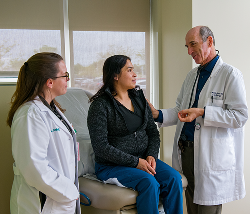
– said Neonatologist Dr. Martha Douglas-Escobar.
Due to her small size and incomplete development, Mia experienced what Dr. Douglas-Escobar calls not an “emergency” but the “expected” problems of extreme prematurity. In addition to her tiny size and need for temperature regulation, Mia had to be fed via an umbilical vein with a combination of glucose and water, carbohydrates, proteins, and dextrose to simulate the uterine and placental environment during Mia’s first weeks of life.
“At first, we were surprised by the pregnancy, and then we were fighting for our child,” Miranda said. “She was on oxygen to help her breathe. She had a breathing tube inserted through her nose and down into her windpipe from the moment she was born, April 15, until January 2. We were constantly watching over her with an oximeter that let us know how she was breathing.”
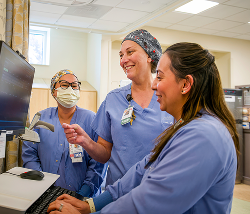
That the medical staff of the Level III Neonatal Intensive Care Unit (NICU) at Natividad has the knowledge, expertise, and determination to provide, moment by moment, precisely what an extremely premature infant needs to thrive is exceptional.
“Our next step was to insert a little tube from Mia’s mouth into her stomach so we could start dripping milk,” said Dr. Douglas-Escobar. “At 10 to 15 days, Mia would be able to tolerate all feedings into the stomach. But she still was not ready to suck or swallow. This would come around 34 weeks of age.”
Then, Dr. Douglas-Escobar and her staff needed to teach Mia how to suck. At first, she was able to consume 5% of her nutrition via the mouth. Once she reached 80 to 85% capacity, the tube was removed, and she was able to eat from her mouth, either by nursing or from a bottle.
Miranda was discharged from the hospital four days after delivery. Mia spent nearly three months in the NICU at Natividad before she was ready to go home. After waiting almost three weeks to hold their child, her parents, Miranda and Jose, came to see her, typically two or three times a day, to hold and change her, and provide skin-to-skin warmth and stimulation, bonding with their child as they eventually bottle- or breast-fed her.

“Today, Mia’s doing great,” Dr. Douglas-Escobar said. “We have a high-risk clinic for premature babies, which monitors the baby’s progress. Mia’s parents have been bringing her to the NICU so our team can see how she’s coming along. It’s been nine months since Mia’s birth and she is growing and developing well and doesn’t demonstrate any deficits.”
These days, Mia is babbling, particularly to music. She is starting to roll over and has tried to take a couple of steps while holding onto her mom’s fingers overhead.
“When she’s in the middle of learning something new, she wakes up more often,” her mother said. “She’s making her development markers and doesn’t want to miss anything.”
It Takes a Village
Through the years, devoted donors, particularly members of The Agricultural Leadership Council (TALC), have demonstrated their understanding of the importance of Natividad to the community’s health care by giving generously to the organization. TALC members have contributed the medical equipment essential to the development and well-being of baby Mia, including her isolette, a clear-plastic, enclosed crib that maintained a warm environment and isolated her from germs. Donors have provided other state-of-the-art equipment, such as the Olympic Brainz Monitor, which provides neurological information during the early stages of newborn development.
“This device collects input from the brain,” said Dr. Douglas-Escobar, “to show if a baby is experiencing seizures. Donors also have provided cameras that help neonatal physicians look for retinopathy or other eye problems. We can provide the care we do because donors are equipping us to do so.”
Sometimes, growing families need to overcome social and financial challenges. If the families of babies who graduate from the NICU don’t have the essentials for homecare, such as a bassinet or crib, a machine for the mother to pump breast milk, or money for gas and transport, NICU staff tap into the Natividad Foundation, which has helped relieve the burden for many families.
“The Foundation has provided bus passes, a freezer to store mother’s milk, diapers — all those seemingly little things,” “that are big for new or growing families, to make sure they are ready to bring home and care for their baby like a car seat to ensure the family travels from our clinic to their home safely,” said Dr. Douglas-Escobar, “Natividad Foundation is a key piece in our continuum of caring for high-risk newborns.”
For nearly a dozen years, the NICU at Natividad has held a Level III designation from the California Department of Health, which means the hospital is ready and able to take care of newborns born before 32 weeks and weighing less than 3.3 pounds or 1,500 grams in NICU terms, as well as newborns of any age and weight who are critically ill and newborns who need special equipment and round-the-clock care to help them breathe and thrive.
“Our NICU serves, among others, a population of migrant workers who, most of the time, have difficulty accessing health care,” Dr. Douglas-Escobar said. “Having results like Mia’s is encouraging, confirming that we can bring our community the benefit of having extremely specialized care for high-risk, premature babies.”